
The Muratorian Fragment is an early list of the accepted NT books in the canon. Just how early is a matter of debate. But whether the Fragment dates to the 2nd or 4th century AD (though I am inclined to agree with scholars who argue that due to internal evidence, the original document dates to around AD 170), this does not take away from the important witness this document affords us to discerning the early church's view of accepted NT books. What is said and what is not said are equally important.
The original Fragment was assumedly written in Greek, but is now sadly lost to us; what we do have today is a 7th century Latin translation of it (see photo of that copy below).

The original Fragment was assumedly written in Greek, but is now sadly lost to us; what we do have today is a 7th century Latin translation of it (see photo of that copy below).
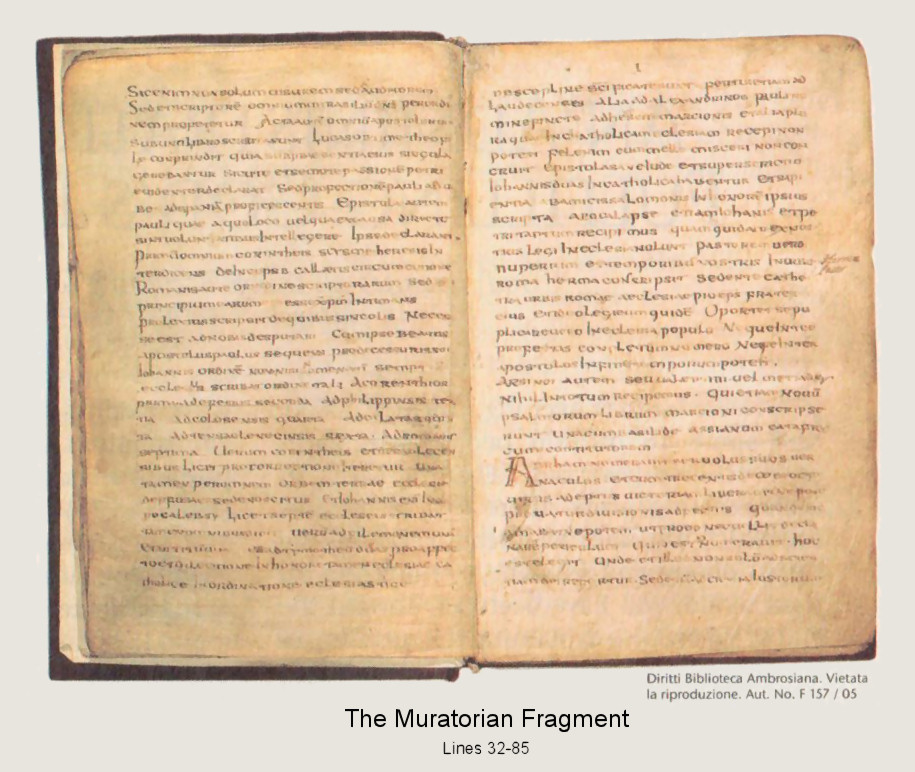
A translation of the lines above (32-85, the end of the document) follows:
(32) For in this way he professes [himself] to be not only an eye-witness and hearer, (33) but also a writer of all the marvelous deeds of the Lord, in their order. (34) Moreover, the acts of all the apostles (35) were written in one book. For 'most excellent Theophilus' [5] Luke compiled (36) the individual events that took place in his presence — (37) as he plainly shows by omitting the martyrdom of Peter (38) as well as the departure of Paul from the city [of Rome] [5a] (39) when he journeyed to Spain. As for the Epistles of (40-1) Paul, they themselves make clear to those desiring to understand, which ones [they are], from what place, or for what reason they were sent. (42) First of all, to the Corinthians, prohibiting their heretical schisms; (43) next, [6] to the Galatians, against circumcision; (44-6) then to the Romans he wrote at length, explaining the order (or, plan) of the Scriptures, and also that Christ is their principle (or, main theme). [6a] It is necessary (47) for us to discuss these one by one, since the blessed (48) apostle Paul himself, following the example of his predecessor (49-50) John, writes by name to only seven churches in the following sequence: To the Corinthians (51) first, to the Ephesians second, to the Philippians third, (52) to the Colossians fourth, to the Galatians fifth, (53) to the Thessalonians sixth, to the Romans (54-5) seventh. It is true that he writes once more to the Corinthians and to the Thessalonians for the sake of admonition, (56-7) yet it is clearly recognizable that there is one Church spread throughout the whole extent of the earth. For John also in the (58) Apocalypse, though he writes to seven churches, (59-60) nevertheless speaks to all. [Paul also wrote] out of affection and love one to Philemon, one to Titus, and two to Timothy; and these are held sacred (62-3) in the esteem of the Church catholic for the regulation of ecclesiastical discipline. There is current also [an epistle] to (64) the Laodiceans, [6b] [and] another to the Alexandrians, [6c] [both] forged in Paul's (65) name to [further] the heresy of Marcion, and several others (66) which cannot be received into the catholic Church (67)— for it is not fitting that gall be mixed with honey. (68) Moreover, the epistle of Jude and two of the above-mentioned (or, bearing the name of) John are counted (or, used) in the catholic [Church]; [7] and [the book of] Wisdom, (70) written by the friends [7a] of Solomon in his honour. (71) We receive only the apocalypses of John and Peter, (72) [7b] though some of us are not willing that the latter be read in church. (73) But Hermas wrote the Shepherd (74) very recently, [7c] in our times, in the city of Rome, (75) while bishop Pius, his brother, was occupying the [episcopal] chair (76) of the church of the city of Rome. [7d] (77) And therefore it ought indeed to be read; but (78) it cannot be read publicly to the people in church either among (79) the Prophets, whose number is complete, [8] or among (80) the Apostles, for it is after [their] time. (81) But we accept nothing whatever of Arsinous or Valentinus or Miltiades, (82) who also composed (83) a new book of psalms for Marcion, (84-5) together with Basilides, the Asian founder of the Cataphrygians [8a] . . .


No comments:
Post a Comment