Showing posts with label Posted by Chris. Show all posts

Thursday, March 1, 2018

Verbs in Mark 15:19

Recently with a translation team, I asked about the verb tenses used in Mark 15:19. The translation at first read,
And they beat him over his head with reed stick, spat on him and knelt down and bowed down to him. (English Back Translation)
We made two changes in this verse, one regarding the final action of this verse (which is not under discussion here) and the other pertaining to TAM (tense, aspect, mood) (the focus of this post).

The Greek verbs here are all in the imperfect form which lead many scholars to conclude that these actions were not just one blow, spit, and kneel but provided a short "video" of some of the persecution our Lord underwent--whether several different people did these actions in turn or one monolithic group did them over and over again. For example, ESV translates "And they were striking...spitting...kneeling"; NIV and NET add "again and again they struck him..."; and HCSB translates as "They kept hitting..."

Once this was explained to the team, they re-read their verse and discovered that they had translated these actions as happening only once rather than repeatedly. By adding "many times," the team adjusted the TAM to more accurately reflect the repetitive nature of these verbs.

This was a dark hour for our Lord, especially since he bore the wrath of his Father who forsook him. But Jesus endured it "for the joy set before him" (Hebrews 12:2 ESV). And Peter wrote, "He himself bore our sins in his body on the tree, that we might die to sin and live to righteousness. By his wounds you have been healed" (1 Peter 2:24 ESV). O praise Jesus for his suffering and his efficacious death, "so that he might bring us to God" (1 Peter 3:18 ESV)!    

Tuesday, February 14, 2017

In Memory of Dr. George Cowan

A dear colleague of ours, Dr. George Cowan, former Bible translator and president emeritus of Wycliffe Bible Translators International, went to be with the Lord on Saturday, Feb. 11, 2017, at the age of 100.

We had the pleasure of meeting George a number of years ago, and our time with him has left an indelible impression on us. It was a joy to get to know such a vital link to the founders of Wycliffe; the Lord used him to help fuel our passion for minority language groups to access the Word of God.

Wycliffe wrote a helpful article entitled "In Memory of Dr. George Cowan" here.

Among many things to mention, one interesting discovery he made was the Maxeteco people's whistling speech (Mexico).

May the Lord raise up many more George Cowans: linguist, Bible translator, mission leader, prayer warrior.

Thursday, February 25, 2016

Great Commissioning To Ezekiel

We are excited to work with translators on the book of Ezekiel. And this translation work on the Old Testament joyfully follows Jesus' commission in Matthew 28:19-20; we argue that translation of Ezekiel is one of the implications of the Great Commission. 

Observe the following:
  1. Jesus' disciples are to teach all nations to observe His commands (Matt 28:20).
  2. "All nations" do not speak one and the same language; there are about 7,000 languages used in the world today (over 500 in Nigeria alone).
  3. Teaching is most effective and best understood in one's own language (e.g., when Jesus taught the 12, He did not speak in a language foreign to them!), so to effectively teach the nations, we should translate Jesus' commands!
  4. In Luke 24:44-47, Jesus' similar command to call all nations to turn to Him flows from His Christ-centered reading/teaching of the Old Testament; the Christ is written about "in the Law of Moses and the Prophets [this includes Ezekiel!] and the Psalms."

Conclusion:
To effectively disciple the nations to follow Jesus' commands includes the implication that Jesus' disciples should translate the whole Bible (including Ezekiel and the rest of the OT).

Wednesday, December 30, 2015

Resolutions

New Years resolutions? I usually don't compile a new annual list for myself for personal goals, but the following two lists have been the most helpful for me over the years.

First, Jonathan Edwards wrote about 70 resolutions in the 1700s.

Second, Clyde Kilby mentioned 10 resolutions in a lecture in 1976, and John Piper has spoken about and published these a few times, including his recent post.
Here are Kilby's 10 resolutions for mental health, according to Piper's article:
1. At least once every day I shall look steadily up at the sky and remember that I, a consciousness with a conscience, am on a planet traveling in space with wonderfully mysterious things above and about me.
2. Instead of the accustomed idea of a mindless and endless evolutionary change to which we can neither add nor subtract, I shall suppose the universe guided by an Intelligence which, as Aristotle said of Greek drama, requires a beginning, a middle, and an end. I think this will save me from the cynicism expressed by Bertrand Russell before his death when he said: "There is darkness without, and when I die there will be darkness within. There is no splendor, no vastness anywhere, only triviality for a moment, and then nothing."
3. I shall not fall into the falsehood that this day, or any day, is merely another ambiguous and plodding twenty-four hours, but rather a unique event, filled, if I so wish, with worthy potentialities. I shall not be fool enough to suppose that trouble and pain are wholly evil parentheses in my existence, but just as likely ladders to be climbed toward moral and spiritual manhood.
4. I shall not turn my life into a thin, straight line which prefers abstractions to reality. I shall know what I am doing when I abstract, which of course I shall often have to do.
5. I shall not demean my own uniqueness by envy of others. I shall stop boring into myself to discover what psychological or social categories I might belong to. Mostly I shall simply forget about myself and do my work.
6. I shall open my eyes and ears. Once every day I shall simply stare at a tree, a flower, a cloud, or a person. I shall not then be concerned at all to ask what they are but simply be glad that they are. I shall joyfully allow them the mystery of what Lewis calls their "divine, magical, terrifying and ecstatic" existence.
7. I shall sometimes look back at the freshness of vision I had in childhood and try, at least for a little while, to be, in the words of Lewis Carroll, the "child of the pure unclouded brow, and dreaming eyes of wonder."
8. I shall follow Darwin's advice and turn frequently to imaginative things such as good literature and good music, preferably, as Lewis suggests, an old book and timeless music.
9. I shall not allow the devilish onrush of this century to usurp all my energies but will instead, as Charles Williams suggested, "fulfill the moment as the moment." I shall try to live well just now because the only time that exists is now.
10. Even if I turn out to be wrong, I shall bet my life on the assumption that this world is not idiotic, neither run by an absentee landlord, but that today, this very day, some stroke is being added to the cosmic canvas that in due course I shall understand with joy as a stroke made by the architect who calls himself Alpha and Omega.

Thursday, December 10, 2015

Ezekiel 1:3 "There"

"The word of Yahweh came to Ezekiel the priest, son of Buzi, in the land of the Chaldeans by the river Chebar, and there the hand of Yahweh came upon him." (Ezekiel 1:3)

The importance of small words may sometimes be overlooked by a casual reader. But in the case of Ezekiel 1:3, it is likely that the word "there" carries great significance.

In Hebrew, the prophet Ezekiel did not need to add this word to ensure that the reader understood the location of where Yahweh's hand came on Ezekiel (see Ezekiel 37:1; 40:1). The seeming superfluity of the word "there" struck me as I read and translated the Hebrew text.

In both Ezekiel 1:3 and 3:22, Yahweh's hand comes on Ezekiel in a specific place - "there" - in the land of the Chaldeans. Dr. Block comments on the likely significance of this specificity:
"For readers who found incredible the announcement that the heavens had opened to an exile on foreign soil, the editor highlights the location by inserting the emphatic 'there.' For those tempted to view Ezekiel's visionary experience as a flight of fancy, the insertion affirms that this was the occasion on which the prophet was conscripted into the divine service" (Ezekiel, 82-83).
Yahweh spoke to His people while they were exiled and away from the Promised Land, and for some, for Yahweh to reveal visions to exiles would have been entirely unexpected. And Ezekiel's vision was firmly grounded in the historical and geographical reality of the exile to foreign land. For some, this is ostensibly shocking activity on Yahweh's part - He revealed things to his people where? Not in the Promised Land but in Chaldean Land? In translation, it is entirely important to somehow capture the highlighting function of this "there." 

Thursday, July 16, 2015

Translating "Slow of Speech and of Tongue"

In Exodus 4:10, we read another reason Moses gives to Yahweh for his reticence to serve as Yahweh's special envoy to Pharaoh.
But Moses said to the LORD, 'Oh, my Lord, I am not eloquent, either in the past or since you have spoken to your servant, but I am slow of speech and of tongue.'
The ESV's wording "slow of speech and of tongue" interprets the Hebrew expression which literally reads, "heavy mouth/lip and heavy tongue."

When we were working with one language group in Cameroon, we came upon that verse in a checking session. Their draft translation had rendered the last part of this verse as "but I stutter [i.e., a physical disability, a speech impairment]."

Two discussion points with the translation team
1. Moses does make a claim about having speech difficulties, but this does not mean he actually did have a speech impediment. To translate the expression as such is too narrow an interpretation. The Hebrew adjective "heavy" here does not at all require meaning "speech impediment" or "stutter." Furthermore, Moses evidently did not have a debilitating and shameful speech problem, despite what he says in Exod 4:10a; he articulated himself just fine in his interactions with the people of Israel and with Yahweh in Exodus 2-4. And his later proficiency with words is well-documented in his interactions with Pharaoh and in his sermons (Deuteronomy). Moses received a good education in Egypt during his first 40 years, and no doubt this education included both reading and speaking.

2.  Many scholars (e.g., see Douglas Stuart's Exodus commentary) are convinced - based on analogous statements in the OT - that this verse may actually record Moses making an excuse based on humble deference (not a statement aligning with reality). Moses could actually articulate with his mouth just fine, but in keeping with common practice of the day, he offered his superior (Yahweh) an excuse that was not actually true of himself: speech difficulties.

Conclusion
Whether or not Moses actually had speech difficulties, the text records that Moses claimed he did. To be more faithful to the Hebrew expression, the team decided to change their translation to a more general expression for speech difficulties rather than narrowly restricting the meaning to a physical handicap. The team also debated whether or not to put a footnote on the bottom of the page to explain that it is plausible that Moses did not actually have a physical impairment (e.g., a stuttering problem), but that he may simply be giving Yahweh a self-deprecating reason to explain his reticence to speak to Pharaoh (in English, we might say "false humility").    

Wednesday, June 3, 2015

Appointed by Yahweh in Jonah 1:17*

"Yahweh appointed a great fish to swallow up Jonah..."
(Jonah 1:17a)

One significant theme in Jonah is Yahweh’s sovereignty.  The Hebrew verb מנה (“to appoint”) occurs four times to detail some of his dominion. He directed the great fish to deliver and transport Jonah (1:17), a plant to shade him (4:6), a worm to strike the plant (4:7), and the scorching wind with the sun to strike him (4:8). The book of Jonah is about Yahweh (see 4:2)!

In 1:17 (above), Yahweh appointed or directed a great fish, meaning that Yahweh made the fish intervene, assigning it a task. This Hebrew verb thus fundamentally entails the sense “to command or order” (S#1), but given the purpose statement in the verse (“to swallow up Jonah”), the translation of the verb should also entail “to designate or name someone/thing” (to a function) (S#2). Yahweh did not send a large fish without aim, but he authoritatively dispatched it (S#1) to accomplish a certain job (S#2). This important and profound verb highlights the fact that Yahweh, as Master of all things, accomplished his will through the fish.

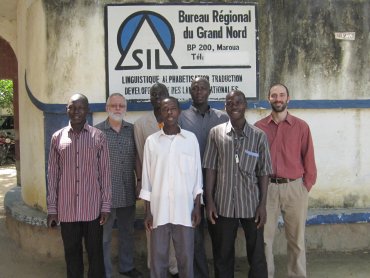
We pray for great biblical wisdom for our dear brothers translating the Word and using these notes in Cameroon (see some of those translators above to the left), and that the Lord would grant the same for other translation teams with whom we have the privilege of ministering.

*Adapted from Chris' Notes for Cameroonian translators.

Friday, May 29, 2015

Swadesh Word List

Historical-comparative Linguistics
Ever wonder what are some tools that linguists use to compare one language with another?

Swadesh List
In Nigeria and in other places, the (final) Swadesh list established 100 words that, once solicited from one language, can provide helpful comparative information in light of other languages. Some linguistic surveyors and other researches have used and continue today to use this resource.

Some words on the Swadesh List
I (personal pronoun)
not
dog
mouth
eat (verb)
die (verb)
bush
fire
name

Swadesh's Full Final List of 100 Terms


Thursday, May 21, 2015

Documentary on the Nyangatom in Ethiopia

From BBC's description of their series Tribe:
Documentary series following former British Royal Marine Bruce Parry as he visits a number of remote tribes around the world, spending a month living and interacting with each society.
The Nyangatom group is one of the tribes he visits, and in the episode devoted to that people group portrays, he some about their way of life, customs and practices.

Here's one section of Tribe's write-up about the Nyangatom regarding their organization:
The Nyangatom are divided into about 20 clans. Membership is by the paternal line – you belong to the clan your father belongs to. These clans vary in size from a few members to several hundred.  
The Nyangatom are also divided into territorial sections. These might be called after a migratory bird (Storks, Flamingos, Ibis); or have ethnic names (Kumam; Ngaric); or other names from nature (Castor Tree).  
The main form of social organisation is by generation-set. The men of one generation-set father the men and women of the next. Each generation is given a name. The very earliest ancestors are called the Founders; their sons were the Wild Dogs, then the Zebras, the Tortoises, the Mountains and so on. The oldest generation-set still living now are called the Elephants; then Ostriches and the Antelopes; or the Birds and the Ibex as they were referred to in the programme. The youngest generation are now known as the Buffaloes.  
Fathers and sons always socialise separately. The Elders remain in the village, while the job of the boys is to herd the goats, who browse on bushes round the village; and the women milk the livestock.  
As part of their initiation, the sons have to show they can look after their Elders. In a ceremony watched by the whole village, the young men each attempt to kill a bull with their spear. A single thrust into its right side pierces the liver and causes a massive haemorrhage, which kills quickly without spilling too much precious blood. It’s the way the men show they can provide for the tribe.  
Once they are initiated, they will become the dedicated fighting force of the village. It’s their job to defend the tribe and the cattle. They will be the ones to spend their days out with the herds, risking their lives to protect them.  
According to tradition, about every 50 years the Elders hand over sovereignty to their sons. In the past this involved a barely hidden form of human sacrifice. After the ceremony the asapan man, who acted as a medium during this transmission of power, lost his status as Father and was sent to die in the bush. The ceremony was outlawed by the Ethiopian Derg (the junta that ruled under Mengistu Haile Miriam 1974-91).

Thursday, July 10, 2014

God Never Change

In Nigeria, personalization of vehicles is done often by adding slogans somewhere to the exterior.  A book of these slogans could be compiled. Here's one for that book: "Every Problem is a Lesson: God Never Change."

In Jos, one of the most common means of transportation is Nigeria's version of the rickshaw, which is locally called a keke (or keke-marwa), in Hausa. The ekes are ubiquitous in Jos, ever since the ban a couple years ago due to the attacks that were happening from motorcycles.


Wednesday, July 9, 2014

"Flying Ants" of Nigeria

Termites as Flying Ants?
The termites above were referred to by some colleagues as "flying ants" so as to sound less disturbing when eating these protein-filled insects (the termites were being set out to dry during our OT workshop in Nigeria).  These colleagues said they would prepare termites for consumption by crushing them up and adding them to the batter for making cookies!  Yum, yum, now there's a recipe to try out on the kids!

Termites are NOT Flying Ants
The danger, however, is that flying ants do not get their real due, since there really is such a thing as flying ants (and they are not termites).  We dare not confuse the two!

Differences between Termites and Flying Ants
Orkin lists some of the primary differences between the two insects:

Winged termites have a straight waist and straight antennae. Their wings are equal in size and are shed soon after they emerge from their nest, or swarm. Winged termites usually swarm in the early spring when it is warm and rainy.
Flying ants have pinched waists and bent antennae and are often mistaken for swarming termites. They have two sets of wings, one larger than the other. Depending on their species, flying ants may swarm at different times of the year.
Question of the Day
So the question naturally becomes, could we taste the difference between a termite cookie and flying ant cookie?


Friday, February 15, 2013

Genesis 17-22: Ça y est!

3 Languages at Genesis 17-22 Workshop
Today was the last day of the 2-week long translation course on Genesis 17-22 for the Matal, Hdi and Muyang languages.  The teams worked hard and did good work.

While I worked in assisting to verify some of the Hdi and Muyang translations, the consultant worked with the Matal, being always ready to help the other 3 additional language groups that were scheduled to come but in the end did not attend.  

Sorry, no pictures for the moment, since I don't have access to my camera's data transfer cable.

Workshopping Genesis 21
Have many anecdotes to share, but I will content myself with sharing one for now.

One of the more difficult texts to translate was Genesis 21:25:
And Abraham reproved Abimelech about a well of water that Abimelech's servants had seized.
A few problems presented themselves for translation, for example: the meaning of the verb "reproved" in the original context, and translating in the respective language "seizing" an impersonal, immovable object.  The word "seize" in at least two of the languages is commonly used for objects that are portable, but not for immovable wells, requiring another, similar verb in the translation. (By the way, these same languages also had difficulties with verses like Genesis 22:2 "Take your son" since their verb for "take" can only be used for objects and not for people.)

Well, this whole idea of seizing, which we discussed it earlier this week, was repeatedly discussed by the translators to the point where today one of the translators said, with a twinkle in his eye as he alluded to this passage, "The other day, I went to the market with my cell phone, and someone seized it. I have not seen it since."


Friday, December 14, 2012

Tomoca Cafe: from Ethiopia

OK. So another post about coffee...

When we were in Ethiopia, we visited Tomoca Cafe's shop and were quite impressed with it and their coffee. According to their website:
TO.MO.CA. Coffee Pvt. Ltd. Co. a family owned coffee-roasing company was established in 1953 in Addis Ababa, Ethiopia. The company name is abbreviated from the Italian Torrefazione Moderna Café, which directly translates modern coffee roasting. TO.MO.CA Coffee is the leading and the first coffee company based in Addis Ababa, Ethiopia.

Tuesday, June 12, 2012

A Hare That Chews Its Cud?

In Le Sycomore 5:1, a Journal about Bible translation for Francophones, an article by René Péter-Contesse entitled "Un lièvre qui rumine ? Pas possible !" (A Hare that Chews Its Cud ? Not Possible!) was written about Leviticus 11. What follows is a summation of key ideas in that article.

The Problem in the Text (cf. Deuteronomy 14:7-8)

Among those that chew the cud or part the hoof, you shall not eat these...And the hare, because it chews the cud but does not part the hoof, is unclean to you. (Leviticus 11:4, 6)
While the text here declared hares to be unclean because of its cud-chewing properties, it is observed that hares do not in fact ruminate, that is, they do not regurgitate their food and eat it once again.


Dismissing Some Current Interpretations
1. Insistence on Ignorance (some inerrantists)

Some claim that since rumination is claimed here for hares, it must be the case that an animal like that either existed on the earth or will be discovered at some point. We discover new species every day, after all. Péter-Contesse dismissed this as not convincing.
2. Transcribe the Word Without Understanding (e.q. Chouraqui)

André Chouraqui claimed that pure transcription of the Hebrew word avoids the problem of needing to interpret and understand the issue, an "elegant" solution according to him.
3. Error in the Bible (e.g. Edouard Dhorme in the Bible of the Pléiade)
4. Imaginary Zoological Classification (e.g. Pierre Buis and Jacques Leclercq in their Deuteronomy commentary)


Two Considerations
1. The principles of animal classification in the 20th century are different than those of Antiquity.
2. It must be studied what the Hebrews would have understood by "ruminate"


Further Thoughts on Classification
Modern zoology was able to study in detail the complex phenomenon and the physiology of rumination in certain animal species. It is obvious that ancient Hebrews and their contemporaries did not ever have access to such in-depth knowledge. The raisers of animals in Antiquity indicated with certainty that their animals, after eating a large amount of grass, sat down and ate a second time the eaten grass. They deducted that the grass had come back up from their stomach to the mouth to experience a second time of chewing. But, they saw the essential element of the exterior, that is, the long, repeated movement of the animal chewing, as in the cow or camel for example...What people noticed when they saw a hare was that his jaw (like a domestic rabbit today) is almost continually moving. From there, it is left to conclude that the hare was possibly chewing for a second time his food. (p. 7)
The hare was not domesticated at this time in Antiquity, so observation of it would have been less scrupulous than that of the cow, for example, which was in close, everyday contact with people.

Translation Recommendations
1. Search a word in the language of an animal action where the mouth is in regular movement to chew food
 2. If #1 does not exist, inevitably consider "ruminate." In this case, a note of explanation might be necessary. Something like, "The Hebrews considered hares and the rock badger as members of the class of ruminators, because they saw their mouths were often in movement."


Monday, June 11, 2012

Study of 2 Kings 18-22: Hezekiah's Two Fathers

In preparation for our language project's workshop on 2 Kings 18-22 in the coming weeks, I have been carefully working through that section of Scripture.  Here's a thought from 2 Kings 18:1-3.

Tale of Two Fathers
In 2 Kings 18:1, we read of Hezekiah's father, or rather (more literally), that he was the son of a certain man named King Ahaz:
In the third year of Hoshea son of Elah, king of Israel, Hezekiah the son of Ahaz, king of Judah, began to reign.
Then, in 2 Kings 18:3, we read of Hezekiah's second father David:
And he did what was right in the eyes of the LORD, according to all that David his father had done.
Translation Considerations
Of course, one reading the whole of 1-2 Kings would have no problems understanding how both of these statements could be true, having read about King David in earlier chapters and how he stood as the head of a line of kings. However, at least in English, the word "father" is rarely if ever used in this expanded sense, and for that reason, versions like the NET have instead opted for "ancestor" to avoid confusion. In the case of a translation like a translation like "ancestor" (which is obviously the sense of the word here), I would prefer a footnote indicating that the typical term "father" was used, in order to preserve the close genealogical link made with David.

One's goal in translating should be to test, discern, and decide whether the translation "father" or something like "ancestor" should be preferred and whether that preference would cause too much conflict (read: complete misunderstanding) with verse 1. In many of the Cameroonian cultures in which I have had contact, the immediate family involves more generations than what we include in ours, for example, the blood relatives grand-father, great-uncle, and uncle may all equally be referred to as "father." This would make "father" a natural choice, and easily understood by the readers.

To discover what terms are used for family relationships, we have used the anthropological tool called kingship charting which collects information on not only the terms used for relationships, but how and who constitutes those relationships.


Sunday, June 10, 2012

Technology and Translation, part 1: LPDT

This is the first post in a series on some different ways that technology interfaces with translation.  This post focuses on a software program for translators and exegetes called Le Pupitre du Traducteur (LPDT, translated as "The Translator's Desk").
LPDT
LPDT puts French language tools in the hands (or computers, rather) of French speakers everywhere, but particularly Francophone Africa, where 400-600 languages are yet to have translation or literacy programs begun. Some facts about this tool, include:

  • Its use began in 1996
  • Used by 160 translation programs right now (incl. Mofu in Cameroon)
  • Includes 8 French Bible Versions
  • Has several dictionaries, Biblical lexicons, and various articles (all in French)

Use in Exegesis and Translation
I have recently received my copy of LPDT and look forward to using it extensively with our team, as this is the main French language exegetical tool available at this moment.  Nevertheless, LPDT won't be replacing my BibleWorks anytime soon (or Logos, if/or when I get that program).  There are simply fewer exegetical resources available in the French-speaking world than in the English-speaking one.

For francophone translation teams, to be able to compare versions of the Bible and reference articles and some commentary of a few books of the Bible is an invaluable tool for the work.

Friday, June 8, 2012

2 NT Books Checked

4 Weeks of Checking 2 Books
For the last 4 weeks, CABTAL invited a translation consultant to check the work of 2 translation teams, the Ngomba and the Ngombale.  Two weeks time were devoted to each team, which proved sufficient time to do the work. The Ngomba had checked the Gospel of John, and then the Ngombale the Gospel of Mark.

While I was able to take part in the checking of the Ngomba's John, I was not able to for the Ngombale. Nevertheless, we had the opportunity to get to know each other and discuss translation during breaks and prayer times, etc.

A few observations, of these checking sessions of John:

1. Technology Congruency
Updated and congruent technology is important to configure from the outset, between the consultant and the language team. At the outset, two different versions of Paratext were being used at first (and there are significant upgrades made in the recent version!), and this could have caused mayhem! Computer problems can wreak havoc on any translation.

2. Complete Text
Work through the text - the entire biblical text - in order, as well as the chapter headings (if present), and then the book summary at the end (if present).  I can see where spot checks simply do not cut it in this important ministry of checking the accuracy of the translation.

3. Know the Language
Request/find information on basic discourse, orthographic, grammatical and linguistic features of the language before meeting with the team. For example, how many and what kind of verb tenses are used for the future? And do they have inclusive/exclusive pronouns? How do they introduce new characters in a narrative? Etc.

4. Pace Varies
Remember that the pace of checking will vary. The first day of checking always goes slower, as the team and consultant become familiar with each other (if this is the first book/work they are checking together).  Additionally in most books, important translation decisions must be made early (e.g. John's 18 verse prologue) and that requires extra time.

5. Consistent Key Words
There are several constraints on working with key words, but one of them is that they can be translated differently in every place they surface. This gets to be quite challenging, but with the search technology on computers, this task is made easier (though not necessarily automatic!).

6. Prayer and Dependence on God
Start sessions not just with token prayer, but with earnest pleading that the Lord show up. Some consultants like to start the session with biblical meditation, which serves to orient the hearts and minds of people on the reason we are doing this linguistic work: glorifying God by enjoying Him and communing with Him over His Word.

7. Good Back Translation
Having both a good, written back translation before the consultant as well as a skilled, non-translation language group member to give a back translation on-the-spot are preferable. This helps to keep the translation honest, while also afford the consultant the opportunity to ask comprehension questions by virtue of how the back translation was given.


Wednesday, May 2, 2012

1 Corinthians 15:58 in 6 Cameroonian Languages


1Kolìn15 : 58
‘‘Ma kæ sɨ nà be sɨ̂ zɨ̀ a woyn-nà ghem ghɨ jûŋ na, yì faytɨ̀ ghal ibɨmi i;zɨ-i, ka yì na neʼà. Yì na ghâblɨ̀-à, felɨ̀ sɨ̂ Bôbo kɨ̀ mɨlvɨ ɨ̀n jɨ̀m bòm ta yi n-kya na ifêl ì zɨ-i sɨ̂ ŋweyn kàʼ yi bû læ̀ lê salû.’’ KOM
1Kɔrinto 15: 58
‘‘Né-ɔɔ́, a-baányaŋ bé edəŋge, nyésumɛn bwâm, dyamdyam déē-hɔ̄btē nyé mekuu ásē. Nyébɛ̂ nyékɛɛe nsɔ́n ḿme nyébənlɛɛ́ Sáŋgwɛ́ɛ́ áʼsō. Nyêbíí nɛ́n bán nsɔ́n ḿme nyébɛnlɛɛ́ Sáŋgwɛ́ɛ́ ké nhɔ́g méesaá ngɛ̂n.’’ BAKOSSI
1Korè15:58
‘‘Nə̀ wèŋ rì də bum yèꞌsə vɛꞌnə fana wèeŋ təəŋ gʉgʉŋ, nə kà sə tsòhò. Wèeŋ gʉ fàha Tà nùumbu pweꞌ bə ntʉʉm awèŋ lòoŋ, bʉ̀ʉsə̀ wèŋ sə gʉ̀ fa Tà sə kà wà cà, bwema am wèŋ na.’’ YAMBA
1ŋwàʼne á mbwò pʉ̀a Korento 15: 58
‘‘Mefɛ́ pɔ́ɔn pentʉ nzẅìŋ, páʼ áa púʼu la, pi tʉte tʉte, tà nÿɔʼ, pi kẅiʼi faʼ mefàʼa Cʉ̀apʉ̀a ńdɔg ńgʉa pɔ́ lê mvfò, ńgwɔ faʼ ńne ńzsé ngie fàʼ gie pi fàʼa, ńtí nue pi ee pʉ̀a Cʉ̀apʉ̀a, á té ge cʉ̀a sẅɛ̀ɛ wɔ́.’’ NGIEMBOON
1 Korinto15: 58
‘‘Mfamfá ŋkhuŋnyə, a pá poʼo po tɔm, ka po seŋ; po kattʉɔ nə faʼ Cyəpɔ ba gɔ dzə, ba jyə́ ga yɔ nə yɔgoʼ tə sɔʼ cyə́ méné nə Cyəpɔ pa.’’ NGOHMALA
1 Korintô15: 58
‘‘Fèt tshàm tse nkôni, ndùlala kà bin magte, kà bin nyiʼte, bin dun nkôni nefaʼ faʼ Tshùaben njon ngelan fa, ndèn ndù faʼ sin ke bʼa banban num Tshùaben.’’ EDOUMBA
 
1Corinthians 15: 58
''Therefore, my beloved brothers, stand firm. Be steadfast, immovable, always abounding in the works of the Lord, for you know that your labor in the Lord is not in vain.'' English