Showing posts with label Ethiopia. Show all posts

Friday, August 12, 2022

Praying for Ethiopia

The Xamtanga of Ethiopia are in a zone of conflict, but they have an active Bible translation project underway (see page 5 of the Pray for Zero prayer guide). Elizabeth and I met them in 2020 at our Psalms workshop. Please join us in praying for the Xamtanga. May the Good Shepherd of Psalm 23 provide for his people!


Friday, July 31, 2015

Nyangatom Storying: Donkey, Dog, and Goat

Once upon a time, Donkey, Dog and Goat wanted to journey to go to a friend's house for a funeral. [They said:] "Let us go there and wail." 
So they set out. While they were walking on the street, they saw a taxi and got in.  
Then the taxi-boy asked them for the money. 
Donkey took out money, paid, and received his change. 
Then Dog got out his money and gave it to the taxi-boy. The taxi-boy took Dog's money and simply did not return the change. 
Goat did not have any money; anyway she did not want to pay because she did not have any. So she said (= tried) to hide at the feet of Donkey and Dog.  
When they arrived where the person had died, they got off the taxi.  
Therefore, when they go on the street nowadays, they remember this: Donkey, because he paid the money and got his change, just walks on the street without bothering. Dog, however, because he did not receive his change, barks whenever he sees a car, and runs after it. But Goat, because she did not pay anything, whenever she sees a car, she runs away.* 
Examining traditional Nyangatom stories like the one above is one means that the Nyangatom Bible translation team employs to ensure that their Bible translation uses natural Nyangatom grammatical features. For example, the Nyangatom story above concludes by focusing on each (animal) character - the donkey, dog and goat who travelled together by taxi - and this can provide a helpful point of comparison when translating similarly-structured biblical stories and/or parables (e.g., Luke 19:11-27). Please pray that the translators would have great discernment as well as consensus and involvement from church leaders in the wording and printing of the Nyangatom Bible translation.

*"Donkey, Dog and Goat," translated into English by Martin C. Schröder and James Lokuuda Kadanya, "A Brief Grammar of the Nyangatom Language" (2011), 57-58. 

Luke 5:10b in Nyangatom

tam Yesu Simon nege "nyirengakin ka akolongit ka naga erawuni yong lokalokan ngutunga."
back translation: Jesus said to Simon like this, "Do not be afraid. From this day on, you will be fishing people."
 
At a workshop in 2012 in Ethiopia, Nyangatom team members worked to discern the grammatical structures in their language. As part of this workshop, the team worked on a draft translation of Luke 5, including the verse translated above - some of the first verses of the Bible translated into Nyangatom! 
 
We rejoice that today the Nyangatom are moving ahead with the Bible translation, and we are excited to serve with them to strive for an accurate translation. Chris is eager to take up his role on the team: to help in biblical languages, translation principles, and organization of the project.

Monday, July 27, 2015

Obama in Addis Ababa This Week

From a USA Today article which helpfully overviews the President's visit:
President Obama became the first sitting U.S. president to visit Ethiopia on Sunday...Ethiopia in particular has been undergoing an economic renaissance. The country’s gross domestic product has grown by more than 10% a year during the past decade. The United States is the country’s fourth-largest trading partner. Still, Ethiopia is one of the poorest countries in Africa, and unemployment stands around 17%. To create jobs, the country’s leaders want to expand trade and maintain growth. 

Wednesday, June 3, 2015

Appointed by Yahweh in Jonah 1:17*

"Yahweh appointed a great fish to swallow up Jonah..."
(Jonah 1:17a)

One significant theme in Jonah is Yahweh’s sovereignty.  The Hebrew verb מנה (“to appoint”) occurs four times to detail some of his dominion. He directed the great fish to deliver and transport Jonah (1:17), a plant to shade him (4:6), a worm to strike the plant (4:7), and the scorching wind with the sun to strike him (4:8). The book of Jonah is about Yahweh (see 4:2)!

In 1:17 (above), Yahweh appointed or directed a great fish, meaning that Yahweh made the fish intervene, assigning it a task. This Hebrew verb thus fundamentally entails the sense “to command or order” (S#1), but given the purpose statement in the verse (“to swallow up Jonah”), the translation of the verb should also entail “to designate or name someone/thing” (to a function) (S#2). Yahweh did not send a large fish without aim, but he authoritatively dispatched it (S#1) to accomplish a certain job (S#2). This important and profound verb highlights the fact that Yahweh, as Master of all things, accomplished his will through the fish.

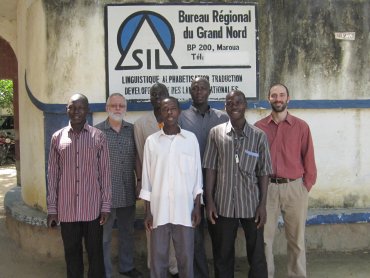
We pray for great biblical wisdom for our dear brothers translating the Word and using these notes in Cameroon (see some of those translators above to the left), and that the Lord would grant the same for other translation teams with whom we have the privilege of ministering.

*Adapted from Chris' Notes for Cameroonian translators.

Thursday, May 21, 2015

Documentary on the Nyangatom in Ethiopia

From BBC's description of their series Tribe:
Documentary series following former British Royal Marine Bruce Parry as he visits a number of remote tribes around the world, spending a month living and interacting with each society.
The Nyangatom group is one of the tribes he visits, and in the episode devoted to that people group portrays, he some about their way of life, customs and practices.

Here's one section of Tribe's write-up about the Nyangatom regarding their organization:
The Nyangatom are divided into about 20 clans. Membership is by the paternal line – you belong to the clan your father belongs to. These clans vary in size from a few members to several hundred.  
The Nyangatom are also divided into territorial sections. These might be called after a migratory bird (Storks, Flamingos, Ibis); or have ethnic names (Kumam; Ngaric); or other names from nature (Castor Tree).  
The main form of social organisation is by generation-set. The men of one generation-set father the men and women of the next. Each generation is given a name. The very earliest ancestors are called the Founders; their sons were the Wild Dogs, then the Zebras, the Tortoises, the Mountains and so on. The oldest generation-set still living now are called the Elephants; then Ostriches and the Antelopes; or the Birds and the Ibex as they were referred to in the programme. The youngest generation are now known as the Buffaloes.  
Fathers and sons always socialise separately. The Elders remain in the village, while the job of the boys is to herd the goats, who browse on bushes round the village; and the women milk the livestock.  
As part of their initiation, the sons have to show they can look after their Elders. In a ceremony watched by the whole village, the young men each attempt to kill a bull with their spear. A single thrust into its right side pierces the liver and causes a massive haemorrhage, which kills quickly without spilling too much precious blood. It’s the way the men show they can provide for the tribe.  
Once they are initiated, they will become the dedicated fighting force of the village. It’s their job to defend the tribe and the cattle. They will be the ones to spend their days out with the herds, risking their lives to protect them.  
According to tradition, about every 50 years the Elders hand over sovereignty to their sons. In the past this involved a barely hidden form of human sacrifice. After the ceremony the asapan man, who acted as a medium during this transmission of power, lost his status as Father and was sent to die in the bush. The ceremony was outlawed by the Ethiopian Derg (the junta that ruled under Mengistu Haile Miriam 1974-91).

Friday, December 14, 2012

Tomoca Cafe: from Ethiopia

OK. So another post about coffee...

When we were in Ethiopia, we visited Tomoca Cafe's shop and were quite impressed with it and their coffee. According to their website:
TO.MO.CA. Coffee Pvt. Ltd. Co. a family owned coffee-roasing company was established in 1953 in Addis Ababa, Ethiopia. The company name is abbreviated from the Italian Torrefazione Moderna Café, which directly translates modern coffee roasting. TO.MO.CA Coffee is the leading and the first coffee company based in Addis Ababa, Ethiopia.

Wednesday, February 15, 2012

Cleared and in the US

It has been a whirlwind!
  • Cleared US Embassy last Thursday, then 
  • Passed US Embassy the following day
  • Received our son's visa that same day
  • Traveled home the next
  • Arrived the day after that
  • Since then, enjoying introducing him to family and friends, and working on re-adoption

Tuesday, February 7, 2012

Holiday Last Weekend

All over the world (except in Saudi Arabia), last Saturday, February 4th was the M*sl*m holiday Mawlid an-Nabi, celebrating the birthday of the prophet.


Saturday, February 4, 2012

The "Ethiopian Eunuch" Was Not Ethiopian

This post summarizes and quotes an article by Peter Unseth called “Semantic Shift on a Geographical Term.”
Acts Background
In the familiar story about Philip the evangelist, he meets a eunuch in a chariot on the Gaza road, Acts 8:26-39. The man in the chariot is traditionally referred to as “the Ethiopian eunuch.” 
And he [Philip] rose and went. And there was an Ethiopian [Aithiops], a eunuch, a court official of Candace, queen of the Ethiopians [Aithiopón], who was in charge of all her treasure. He had come to Jerusalem to worship (Acts 8:27)
Summary of the Position
Unseth’s article argues against the legitimacy of the word “Ethiopian” in this context, showing that there has been a semantic shift from the meaning of Aithiopia to the meaning of “Ethiopia” in English and other languages at the end of the 20th century.
To whom did the Greek words Aithiops and Aithiopón refer?
  1. The very broad meaning, e.g. “black” or “African,” or
  2. The narrower, specific definition of northern Sudan and Southern Egypt 
Two Evidences that the Eunuch was from Northern Sudan/Southern Egypt
1.  Herodutus’ Ethiopia. 
In the 5th century, he wrote, “Ethiopians inhabit the country immediately above [i.e. south of] Elephantine... you will arrive at a large city Meroë, this is said to be the capital of all Ethiopia” (book 2.29). The city of Meroë was located in what is now the northern part of Sudan, north of Khartoum, on the Nile between the 5th and 6th cataracts.

2.  Queen’s Title Candace was Meroitic. 
The eunuch’s queen is referred to as Kandakés, (traditionally transliterated as Candace in English), which is another link with Meroë. This is not a name, but “seems in fact to be a corruption of a Meroitic title (kdke) which was borne by all the royal consorts or queen-mothers of Kush” (Adams 1977:260). 
Problem of Semantic Shift
  • “Ethiopia” in old English (more than 150 years ago) = “a person with black skin,” Oxford English Dictionary
  • Starting in late 1800s, “Ethiopia” in English has been used in much more specific sense for particular state in northeastern Africa, now a republic.
Traditional Practice in Handling the Passage with “Ethiopia”
  • Over 45 English translations all translated the word “Ethiopia” in this verse without a footnote or textual note to address the issue of the modern location problem
  • One English translation (The Twentieth Century) translated as “Abyssinia”, which is nearly synonymous geographically, though it does not designate a political state.
  • European languages unanimously translate as the state of Ethiopia
  • One European translation exception (Polish) translated it as “black people”
  • World’s languages translate with their equivalent of “Ethiopia” (e.g. Habesh, Arabic)
  • About a dozen Ethiopian languages translate unanimously as modern “Ethiopia”
  • 13 translations in Sudan translate as “Ethiopia” or Arabic-based equivalent
  • Only 1 translation in Sudan (Mabaan language) referred to the word as “Sudan”
  • UBS Handbook, Louw and Nida, Newman and Nida, traditional references for translators, all commend to translators to refer to this passage as modern “Ethiopia”
  • Serious commentators (e.g. Thompson, Marshall, Neil, Munch, Williams, Lenski, et al.) unanimous that eunuch’s homeland was not Ethiopia but Sudan (#2 above)
Some Problems in Translating the Passage as “Ethiopia”
  • It is a wrong, misleading term, an incorrect translation
  • Many have assumed that the Ethiopian Orthodox Church, a church with ancient roots in Ethiopia, can trace her origin to the conversion of the eunuch and his subsequent evangelistic efforts upon his return to his homeland. 
  • There is no reliable record of the eunuch planting a church anywhere, not even in his homeland in Meroë. “One may presume that the conversion of the eunuch of Candace remained an isolated fact, with no impact” (Vantini 1980, quoted in Crocker 1986:71 and Unseth:4)
  • The Ethiopian church traces its origin to the 4th century AD, when Frumentius, a shipwrecked Syrian Christian was used by God to lead to the conversion of the Axumite king, Ezana
  • This early delivery of the Gospel to an “Ethiopian” reaffirms the mistaken idea held by many Ethiopians that of all the peoples of the earth, God has a special relationship with not only the descendants of Israel, but also with the peoples of the state of Ethiopia
  • There is a compounded error of misidentifying Candace with the Queen of Sheba, the Queen of Sheba being popularly believed in Ethiopia to have been from the present state of Ethiopia
Suggested Solutions for Acts 8:27
1. “Ethiopia”: 
Negative - Avoid translating as this, as the present state in the Horn of Africa

2. “Sudan”: 
Positives - geographically more accurate, 
Negatives - but less than ideal. The queen did not rule over much of Sudan, and Sudan’s borders have been and are pressure to be changed

3. “Nubia”: 
Positives - This ancient, broad, geographical label included the area of Candace’s reign and there is no current political state called “Nubia.” Would probably require an explanatory footnote, but would not confuse readers with the present state of Ethiopia
Negatives - In contemporary Sudan, however, Nubia refers to a specific area and to specific peoples within the borders of Sudan, so for languages in Sudan, extra testing would be required

4. Neutral term politically: 
Positives - For many non-African languages, it might be specific enough to say that the eunuch was from Africa (or northeast Africa) and that “Candace was queen of part of Africa.” For languages in Africa, this may be too broad, so a narrower geographic term might work, referring to the Upper (or Middle) Nile.

5. “Meroë”: 
Positives - Could state Candace was “queen of the people of Meroë,” then insert an explanatory footnote about the region

6. Combine “Meroë” and neutral politics: 
Positive - Possibly translate, “Meroë in northeast Africa”

Thursday, January 26, 2012

The Photo on which a Pickpocket Capitalized

I was guarding my wallet the entire Timkat celebration except for during this shot when we were passing an ark of the covenant (and the picture did not even turn out that well!):
  • Right hand holding camera to take the picture
  • + Left hand on friend's shoulder so to stay together 
  • = no hands on wallet = pickpocket!
And be especially on your guard in places of close contact where the traffic is moving both directions!


Wednesday, January 25, 2012

Updated Overseas Address Received

The Embassy received our updated address from our updated home study, so now we wait for the Embassy to screen our application, review it, and notify us. Waiting is so hard!

Tuesday, January 24, 2012

Timkat in Ethiopia

Timkat = Ethiopian Orthodox Church celebration of Epiphany.

Wikipedia sums up well some of the differences between Western and Eastern celebrations of this holiday:

Ps. because the minibuses could not drive through the mass of people at this Timkat celebration in Addis last Friday, we had to walk back (over 6 kms) from the grounds to our home.


Friday, January 20, 2012

Bible Translation, Ethiopians, and MN

This week, I read this Star Tribune article reporting on the Christian Oromo community (a people group in Ethiopia) celebrating 100 years of their Bible being translated.

An Oromo slave named Onesimus was freed by some Swedish Lutheran workers and he subsequently went to work translating the Bible into his mother tongue, Oromo.  The Oromo people have experienced great persecution from many sides: political, religious, etc., and so there is a significant Oromian diaspora.

The 100 year anniversary of the translation was in December 1999, and since there are a number of Oromo Christians who are Lutheran who live in the Twin Cities, there was a celebration at the Oromo Evangelical Lutheran Church in Minneapolis.

Praise God for His severe and kind providence!


Thursday, January 19, 2012

Ethiopian Staple: Injera

Injera bread is eaten everyday in Ethiopia, and I have even regularly seen kids eat it for part of their breakfast.  Wikipedia's article explains the background, ingredients (Teff grain, etc), and much more.

We have eaten it several times with dishes like Firfir, Shira Wat, and Doro Wat. 
  • In Amharic, the English word 'spicy' translates as 'red' so beware of those dark red dishes!  They are truly hot! 
  • No utensils, just eat your right hand!
  • Below a 12-vegetable (meat fasting) sampler plate on a bed of injera bread.

Wednesday, January 18, 2012

Adoption Update from Addis

Internet connection has not been the best for us here in Ethiopia, explaining why we have posted so little during this crucial time of bonding with our son here.  However, we will update the blog when we can...

Already accomplished
Passed court (just after Christmas)
Received court decree
Birth Certificate
Passport Application
Received Ethiopian passport
Embassy medical check-up
Submitted visa application to embassy for US visa

To come
US Embassy does their investigation, interviews us, gives clearance and appointment
Travel to US
Travel to Cameroon

We are praising the Lord, for it is He who has done this work of bringing us together with Christopher (Toph) and in such a short time, has granted that we be submitted to the US Embassy.  Our confidence in our Father has grown incredibly through our time in Addis, as He has answered hundreds of prayers, and we pray that Toph trust in Him with an unshakable faith like the cloud of witnesses in Hebrews 11.

Additional prayer request: Our updated home study was delayed in being submitted to the US, and the overseas address on our visa application here in Addis does not match that update. Our prayer is that the US will communicate this update to the Embassy in Addis quickly, that the temporary discrepancy will not hinder the processing at all of our visa request, and that we would continue to trust in the Lord through each 'bump' in the road.